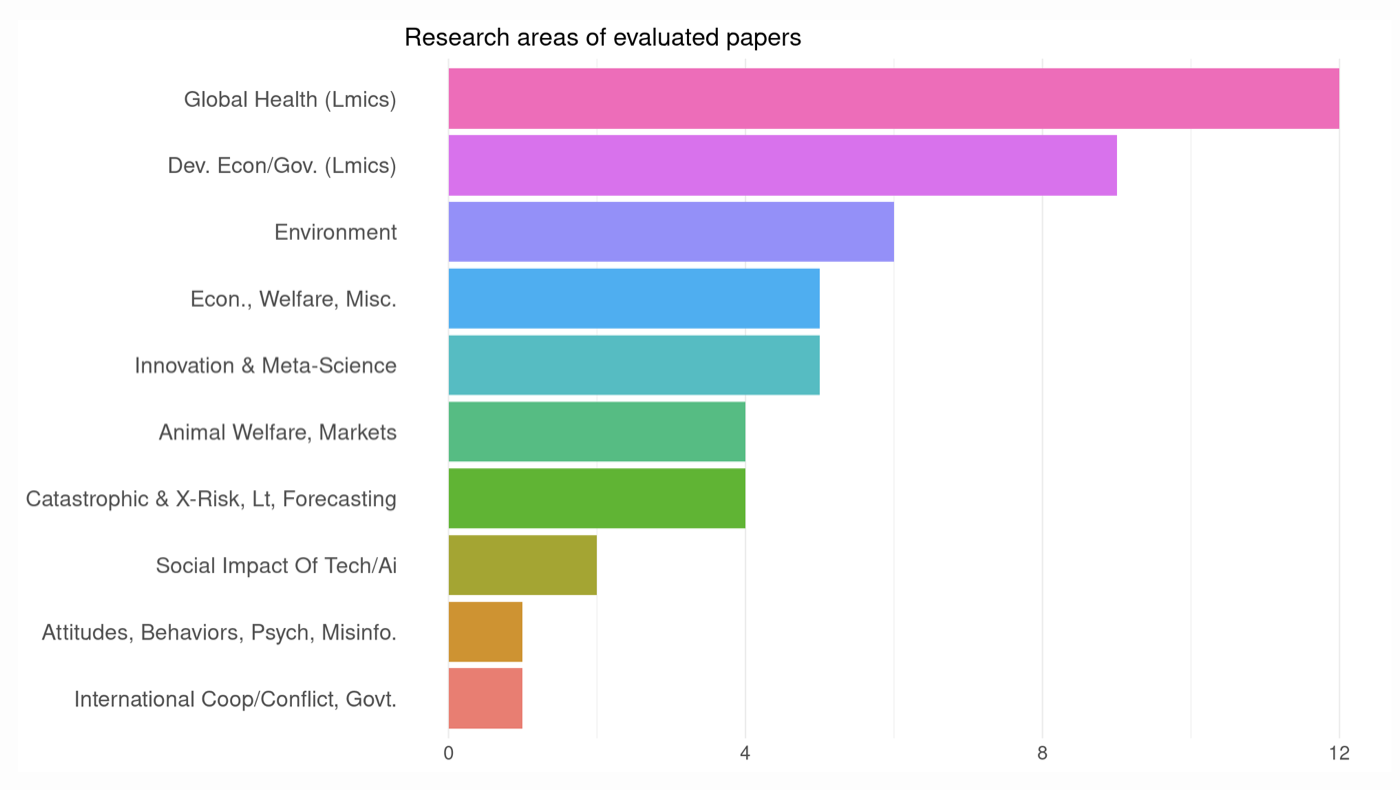
The Unjournal commissions expert evaluation and rating of research, and publishes it openly. Since our creation in 2023, our field specialist teams have identified and prioritized research for public evaluation based on its potential for global impact — including research on women's health, universal basic income, animal welfare, the social impact of AI, environmental hazards, and de-democratization. More recently we have been working with impact-focused organizations to identify and assess their Pivotal Questions.
We now offer research curation and evaluation on a limited basis, in line with our mission, ethics, goals, and our continuing role as a neutral evaluator. We invite research teams, research users, practitioners, and funders to commission evaluation projects. These could focus on a specific policy question, a research area, or outputs from your own teams, from research groups you fund, or from particular papers your work relies on.
Interested on a smaller scale? We're also asking whether individuals and organizations would want to sponsor evaluations of particular papers or themes we have already prioritized. That's an idea we're gathering views on, not a programme we've committed to — tell us what you think.
What a commissioned project can look like
- A series of evaluations on research aligned with your mission and goals, in a particular area (for example, water, sanitation, and hygiene) or on a particular question (for example, the effect of prison sentence length on recidivism).
- A commitment to evaluate a collection of research you funded in a certain area.
- A selection of research from a particular team within your organization.
What you get
- Evidence you can act on. We curate, synthesize, communicate, and evaluate research to inform funding, policy, and advocacy work.
- Independent quality control. We commission and manage transparent assessments of research: detailed expert reports and quantified ratings benchmarked against comparable work. That gives both quality control and external credibility for research you produce, fund, or rely on.
- Recognition. Sponsors are named on the published evaluations and in outreach materials.
- Engagement. We work with you to advance credible and useful research, and to get evidence in front of the people making decisions.
Our evaluations page sets out how the process works: each evaluator writes a structured assessment and rates the work on seven criteria, with explicit confidence bounds. Everything is published open-access with a DOI.
Questions we get asked
- Why would we want public feedback on our work?
- Submitting your research and engaging with public evaluation signals that you're confident in your approach, open to criticism, and trying to get at the truth. Making the feedback public, and responding to it publicly, can also bring in the wisdom of the crowd, get others interested in the work, and attract collaborators.
- Why sponsor evaluation of research we fund or rely on?
- We can give you a faster and clearer feedback loop than traditional journal peer review, on two questions in particular: are you getting good value from the research you pay for, and is it seen as credible by other experts in that specific area? And how much should you trust the research your funding and policy choices rely on — are you using it appropriately?
- What if the feedback is negative?
- We can't guarantee that evaluators will rate your work highly. If we did, the ratings would be meaningless. Like all quality signals, our evaluations are noisy, and we try to limit that through vetting, checking, and multiple sources of validation. If research you produce or fund gets a low rating, you might worry about your reputation, morale, or funding. But most researchers expect opinions to differ about a piece of work, and everyone has had negative reviews. We think this is usually an acceptable risk, counterbalanced by the benefits above and by what it signals about your openness to criticism. You can respond to the evaluations, incorporate the suggestions, and have the revised work evaluated again.
- Why can't we do this evaluation internally?
- Many research-active organizations have internal vetting. It's costly and it has limits. It's hard to be open and honest with people on your own team, especially when offering criticism, when power relationships and career incentives are in play; giving that feedback can be stressful and strain working relationships. The Unjournal is not part of your team. Depending on your size, you're also unlikely to have people with exactly the right expertise — even very large organizations may have only one person with a particular skill set. We recruit experts from within our pool of 200+ evaluators and beyond.
- Why not source external experts ourselves?
- Some organizations do, using their own professional networks. Two limits. First, it's a bother: it takes administration and contracting, it distracts your team, and you have to come up with rubrics, find expertise, and chase consultants. We already have a process for that. Second, it doesn't remove bias or conflict: your research leads still decide whom to consult, what process to follow, and how to characterize the results, which leaves room for actual or perceived unfairness. We have a set process and no stake in the outcome.
- Why not just submit to a peer-reviewed journal?
- You're welcome to do both — our evaluation isn't exclusive. But we can be quicker, we give quantified ratings, and we commit to in-depth, informative reports. There are fewer hoops: you don't need to turn the work into a 32-page PDF with a 100-page appendix, and we can evaluate research in any format, including dynamic documents, data dashboards, multiverse analyses, and interactive websites. Your work stays public, with no paywalls or article processing charges. We can also give expert scrutiny to niche applied research that top journals would likely desk-reject as insufficiently general; lower-ranked specialist journals are less likely to provide global expertise, detailed methodological feedback, or external credibility.
- Why not just submit to The Unjournal's main stream?
- Please do — here's our submission form. But we manage the process carefully and pay evaluators and evaluation managers out of existing grant funding, so our capacity is limited. Our team nominates, discusses, and votes to prioritize research for evaluation, weighing its potential for global impact heavily. We can't guarantee that any particular submission will be evaluated. If you need a specific project or research line to get evaluation and feedback, let's talk about commissioning a project.
Terms: alignment with our mission
In line with our nonprofit 501(c)(3) status, our mission, and our continuing role as a neutral evaluator, commissioned work has to fit our ethics, goals, and approach.
- Public evaluation
- Most of these evaluations should be publicly accessible, including at unjournal.pubpub.org where relevant. It matters most to share the parts that are in the global public interest. We will consider exceptions and adjustments: deferring release until a set date, redacting sensitive content, or giving qualitative evaluations without quantified ratings.
- Arm's length
- We select the expert evaluators and give them guidance and feedback. Sponsors are kept at arm's length from evaluator selection and from the evaluation process.
- Evaluator conflicts of interest
- We aim to make sure evaluators have no major conflicts of interest, including with the funding organization, and we publicly disclose anything COI-relevant, in line with our general COI policy.
- Organizational conflicts of interest
- An organization funding a sponsored evaluation should not currently have other work in our main, unsponsored stream. If we later evaluate work from the sponsor organization, or from authors with ties to it, we disclose that in those evaluations.
- Sponsorship disclosure
- The sponsorship and funding are made public. Our outputs state clearly that the evaluated research was prioritized because of the sponsorship.
- Research in the public interest
- Unlike our main stream, this research doesn't need to be among the most important for global welfare. But the research, or the question it addresses, must have some social value.
Start a conversation
Email contact@unjournal.org and we'll respond within 48 hours, or schedule a call with David Reinstein.
A note on wording: our evaluations page uses "commissioned evaluations" for research that we select and commission ourselves, which is most of what we publish. This page is about projects that an outside funder, organization, or research team sponsors.
Last updated: October 2026. Ported from the previous page at /commissioned-evaluations-1.